Canada has started October 2026 with a bang. In just the first two weeks of the month, Immigration, Refugees and Citizenship Canada (IRCC) held four Express Entry draws and invited more than 11,700 candidates to apply for permanent residence. Trades workers, provincial nominees, French speakers, and people already working in Canada all got their turn.
If you have been thinking about moving to Canada for work, this is the moment to pay attention. 2026 is already a record year for Express Entry, and the pattern of the draws tells you exactly who Canada wants right now. This guide breaks down the October results, explains how category-based draws work, and gives you a clear step-by-step plan to get into the pool.
October 2026 Express Entry Draws: What Happened So Far
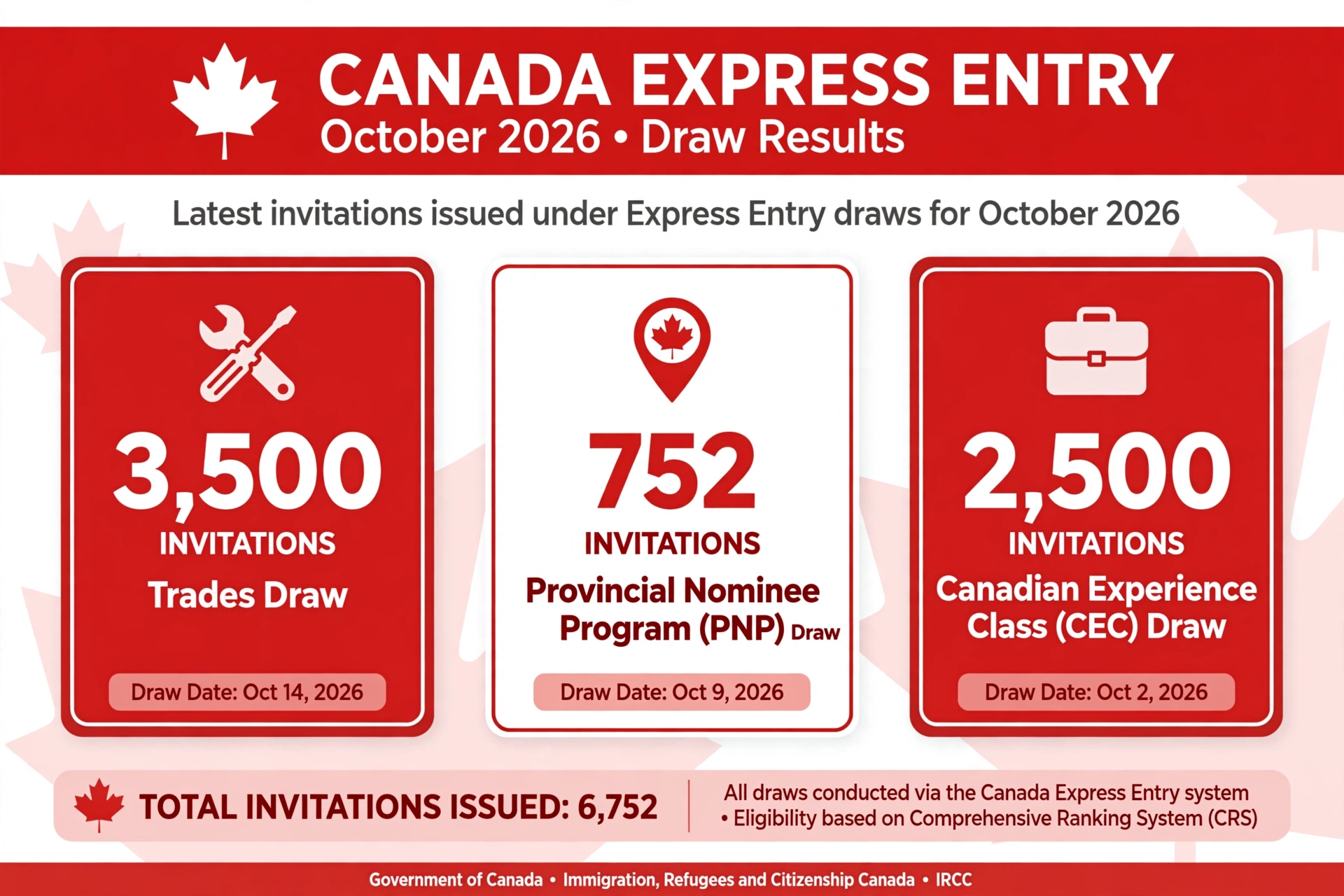
Here are the three draws IRCC has held this month, with the official numbers:
- October 1, 2026 — Draw #447 (Trades Occupations): 3,500 invitations issued, minimum CRS score of 476. This was only the second trades-specific draw of 2026 — the first one, back in April, invited 3,000 candidates at a cut-off of 477.
- October 13, 2026 — Draw #448 (Provincial Nominee Program): 752 invitations issued, minimum CRS score of 772. PNP candidates always show high cut-offs because a provincial nomination adds 600 points to a profile.
- October 15, 2026 — Draw #449 (Canadian Experience Class): 2,500 invitations issued, minimum CRS score of 519. That is 500 more invitations than the previous CEC round on September 29, which invited 2,000 candidates at a cut-off of 518.
- October 16, 2026 — Draw #450 (French-language proficiency): 5,000 invitations issued, minimum CRS score of 435. The largest single draw of the month so far — and the lowest cut-off, showing once again how valuable French-language skills are in the Express Entry system.
For context, September also delivered big numbers: a Healthcare and Social Services draw on September 4 invited 3,500 candidates at a CRS of 475, and French-language draws in August invited 5,000 candidates at cut-offs as low as 382 — the lowest of any major category this year.
Across all of 2026, IRCC has now held 61 draws and issued 140,967 invitations to apply — a new annual record. The biggest shares went to Canadian Experience Class candidates (57,250), French-speaking candidates (55,500), and healthcare workers (11,500).
Why Category-Based Draws Matter More Than Ever
Express Entry used to work like one big competition: everyone in the pool, highest scores win. That is changing. In 2026, IRCC has shifted decisively toward category-based selection, where it runs separate draws for specific occupations and skill groups.
What does that mean for you? Your occupation can matter more than a perfect score. A trades worker with a CRS of 476 got invited on October 1, while a general candidate with the same score might wait months for a round that includes them. If your job falls into one of Canada’s priority categories, your path can be significantly shorter — even with a modest CRS score.
The 7 Categories Canada Is Prioritizing in 2026
IRCC has confirmed it is focusing its category-based draws on these seven groups:
- Healthcare and social services professionals — nurses, care aides, social workers and related roles.
- Skilled trades workers — electricians, plumbers, carpenters, welders, mechanics and similar trades.
- STEM professionals — science, technology, engineering and mathematics occupations.
- Transport workers — truck drivers, pilots and related transport occupations.
- Educators — teachers and early childhood educators.
- French-language proficiency candidates — strong French skills open the lowest cut-off draws of the year.
- Doctors, researchers and senior managers with Canadian work experience — a newer targeted group, with a September draw inviting 250 candidates at a CRS of just 389.
One honest note: belonging to one of these categories does not guarantee an invitation. It simply means you become eligible for dedicated draws with lower competition. You still need an active, accurate Express Entry profile.
How to Enter the Express Entry Pool: Step by Step
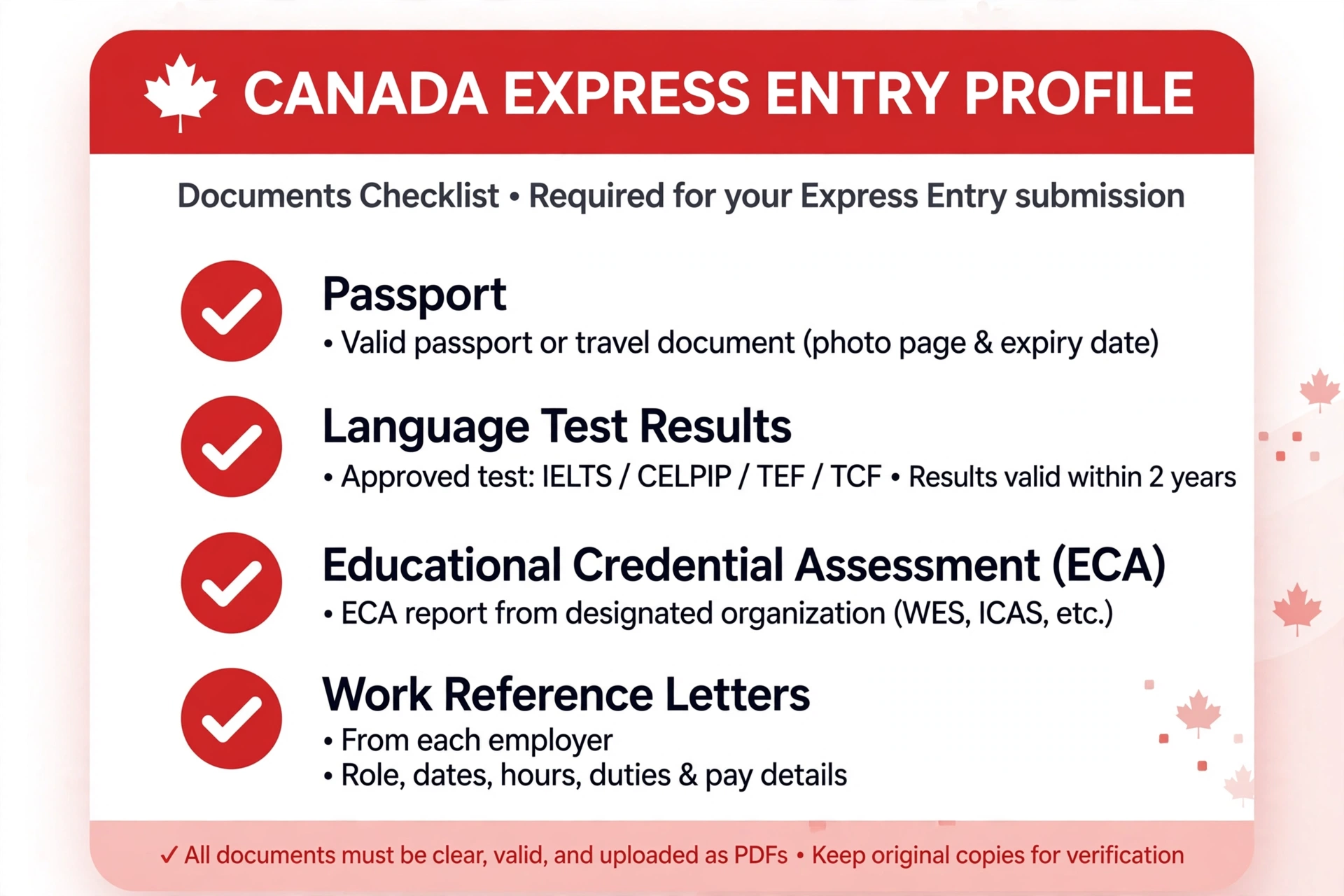
If you are outside Canada and wondering where to start, here is the practical sequence:
- Check your eligibility. Express Entry manages three programs: the Federal Skilled Worker Program, the Federal Skilled Trades Program, and the Canadian Experience Class. Most overseas applicants start with the Federal Skilled Worker Program, which scores you on age, education, language, and work experience.
- Get your credentials assessed. If you studied outside Canada, you need an Educational Credential Assessment (ECA) from a designated organization. This proves your degree or diploma equals a Canadian one.
- Take an approved language test. For English, that means IELTS General Training or CELPIP. For French, TEF or TCF Canada. Your scores feed directly into your CRS points — and strong French scores can unlock the lowest cut-off draws.
- Find your NOC code. Every occupation in Canada has a National Occupation Classification code. Getting this right matters, because category-based draws select by occupation.
- Create your Express Entry profile online. This is free and done through your IRCC online account. You will receive your CRS score immediately.
- Keep your profile alive and updated. Profiles expire after 12 months. Update yours whenever you get new language results, more work experience, or a new credential.
6 Ways to Raise Your CRS Score
- Retake your language test. Even a small jump in your CLB level can add meaningful points.
- Add your spouse’s credentials. A spouse’s assessed education and language scores can contribute points.
- Build more skilled work experience. Additional years in an eligible occupation push your score up.
- Pursue a provincial nomination. A nomination from a province adds 600 points — effectively guaranteeing an invitation, as the October 13 draw showed.
- Learn French. French proficiency earns bonus CRS points on top of your English score, and opens dedicated low cut-off draws.
- Consider studying in Canada. Canadian education credentials and in-Canada work experience are heavily rewarded — the core idea behind the Canadian Experience Class.
Mistakes That Can Cost You an Invitation
- Letting your profile expire after 12 months without resubmitting.
- Entering the wrong NOC code for your actual job duties.
- Forgetting to update your profile after new test results or a promotion.
- Missing the 60-day deadline to submit documents after receiving an invitation — an ITA is not permanent residence until the application is approved.
Conclusion
October 2026 confirms what the whole year has been showing: Canada is inviting skilled workers at a record pace, and it is doing it through targeted, category-based draws. Trades workers and healthcare professionals in particular are seeing dedicated rounds with reachable cut-offs, while French speakers enjoy the lowest thresholds of all — today’s 5,000-invitation French-language draw at CRS 435 proves it.
The window is open, but draws are unpredictable — nobody knows the next date or cut-off in advance. The smart move is to get your profile into the pool now, keep your documents ready, and check the official results after every round. Your invitation could be one draw away.
Draw results change with every round. Always confirm the latest numbers on IRCC’s official Express Entry rounds page on canada.ca before making decisions.